Sponsored
Modern QA teams are under pressure to move faster, scale intelligently, and integrate AI deeply into development cycles. That means testing platforms must understand application context, provide deep infrastructure control, and generate tests at scale with AI beyond just automating tasks.
Two platforms stand out in conversations today: TestGrid vs ACCELQ.
But while they’re often mentioned together, they are not built for the same purpose.
TestGrid is a modern software testing platform designed for enterprise engineering teams, with AI-first automation, real-device infrastructure, and open-source alignment at the core. ACCELQ is simply a codeless test automation platform built for packaged enterprise apps and business-process automation.
This blog compares TestGrid and AccelQ and gives you first hand information on which platform has an edge over other.
Usage Models: Who These Platforms Actually Built For
TestGrid: Built for engineering, DevOps, and modern QA

Modern teams iterate fast, and they need a tool that matches engineering velocity, not constraints. TestGrid is built exactly for this. It’s an infrastructure-centric platform that strongly emphasizes AI-driven automation, flexible deployment, and modern delivery speed.
The platform is mainly designed for engineering, DevOps, SDETs, and modern QA teams who need flexibility, speed, and infrastructure control in their day-to-day testing workflows.
TestGrid is for you if your team:
- Comprises tech and non-tech members who want a mix of codeless and code-based testing interfaces
- Wants multiple testing options in one place — including web, mobile, API, performance, and security testing
- Needs complete control over testing and deployment infrastructure; TestGrids offers private cloud, on-prem, and public cloud deployment support
- Wants to generate tests in bulk with AI help, and scale testing on real devices
- Prioritizes support for open-source toolchains so they can build and customize their testing processes the way they want
ACCELQ: Good for ERP-centric QA. Limited for engineering-led QA
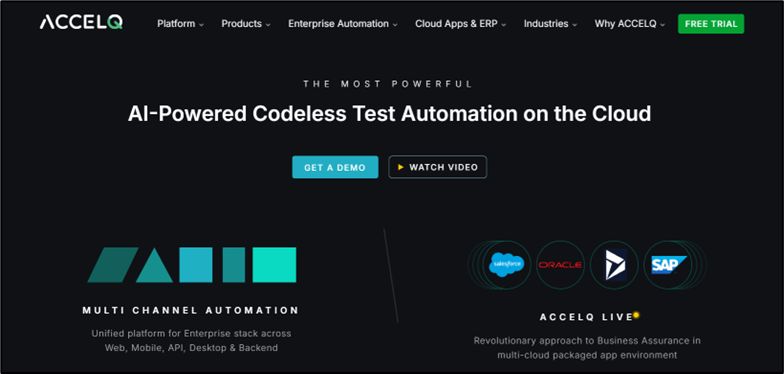
ACCELQ is for QA teams who work with packaged apps Salesforce, Oracle, SAP, ServiceNow, and similar ERP systems, and have heavy governance requirements.
ACCELQ’s approach is strongly scriptless and business-process driven, which makes it well-suited for packaged enterprise apps.
However, engineering-led QA teams that need open-source flexibility, custom pipelines, or infrastructure-level control may find its modeling approach restrictive.
It doesn't provide real-device lab capabilities or infra-aware execution the way TestGrid does, especially for microservices or API-heavy product stacks.
sbb-itb-cbd254e
Enterprise Depth: MDM, Metrics, Reporting, Control
TestGrid: Enterprise control, unified reporting, full infrastructure visibility
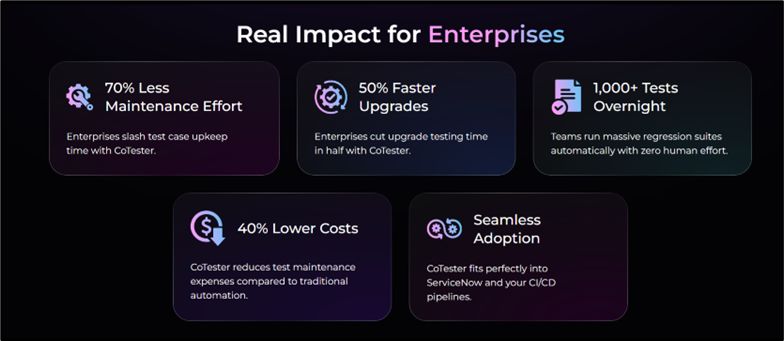
TestGrid provides the kind of enterprise-level features modern engineering and QA teams expect. You get centralized MDM for secure app testing, device provisioning, detailed usage insights, and VPN-enabled setups.
The platform’s enterprise-grade MDM and access controls allow you to:
- Provision devices and assign devices to your teams inside your private lab
- Schedule OS and app updates
- Monitor device usage and enforce enterprise policies
- Manage up to 50 devices and browsers per enclosure through an integrated console panel, with each optimized for low-latency and high-throughput testing.
And for every execution, you get detailed visual reports enriched with screenshots, video logs, and error tracking, as well as keep results, reports, and test history consolidated in one place.
These features give your enterprise a single system of record for all your tests, devices, and environments, not multiple fragmented systems.
ACCELQ: Strong workflow automation; limited enterprise infra depth
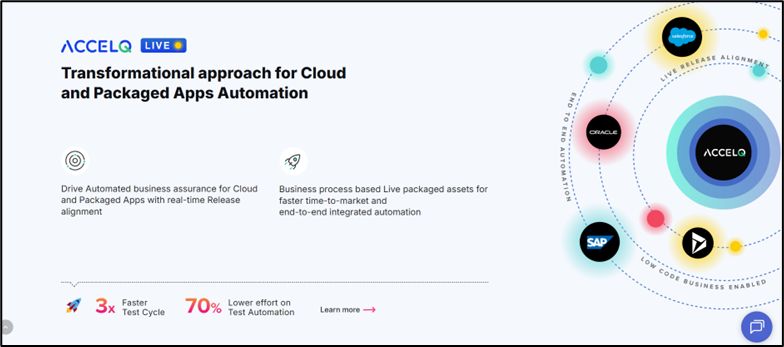
ACCELQ helps you validate app workflows across 3rd party devices and browsers via a single interface. You get reports of test runs, execution time, and pass/fail information. Plus, the Project Dashboard feature gives you real time visibility into execution outcomes, user activities, and test assets.
What ACCELQ’s enterprise governance features include:
- Functional version control to track business changes
- Complete built-in audit trails
- Role-based access controls, and
- Automatic alerts for dependency changes
However, ACCELQ doesn't offer some infrastructure-level features that enterprises often require, especially around real-device management and deeper visibility into hardware-level performance.
- No device-level MDM
- Limited ability to monitor real device and browser performance metrics
- Limited ability to monitor real-device health, device allocation, and infrastructure metrics
ACCELQ’s reporting framework focuses on automation assets and workflow validation, but it doesn't provide unified visibility for device-layer metrics or runtime infrastructure health, which means enterprises still depend on external systems for real-device monitoring.
ERP Tool Support: Accelerators vs Flexibility
TestGrid: Flexible ERP coverage without vendor lock-in
If your ERP apps have a web or mobile interface, you can seamlessly test them with TestGrid by creating scriptless tests and executing them on multiple real devices and browsers in parallel.
Since enterprise apps often go through frequent tests and releases, you can easily integrate TestGrid with CI/CD tools like Jenkins, Azure DevOps, and CircleCI, and trigger automated tests.
TestGrid is ideal if you want broad ERP coverage via modern web or mobile experiences, without vendor lock-in.
ACCELQ: Strong for packaged apps, rigid beyond them
ACCELQ is designed for systems beyond standard web and mobile apps. It can support database testing (Oracle, SQL Server, MySQL, PostgreSQL), message queues (Tibco, ActiveMQ, RabbitMQ, IBM MQ), NoSQL testing, and SSH testing to cater to ERP app testing requirements.
In addition, ACCELQ offers pre-built codeless automation test assets that are business process modeled, so you don’t have to build everything from zero.
Even though ACCELQ offers strong accelerators, tests are structured around vendor-specific models, which makes it difficult to customize tests outside pre-defined modules. And, when apps use custom flows, the model-based automation can become brittle.
Infrastructure & Own-Infra Control
TestGrid: Infra-first control with cloud, on-prem, and private device labs
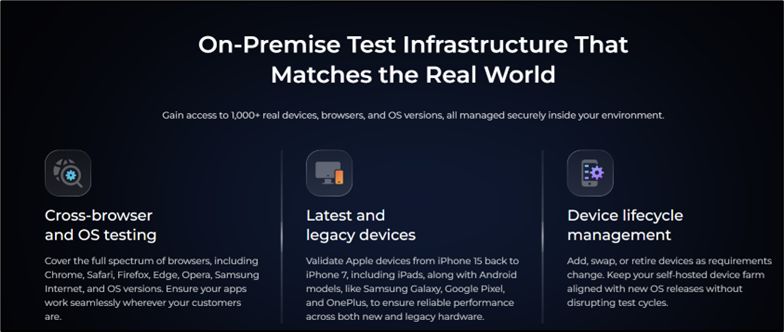
Owning infrastructure is critical for enterprises. This is because it gives teams tighter data privacy, faster execution close to internal systems, and offline testing for highly regulated environments.
This helps you reduce reliance on the vendor's cloud and keeps your sensitive data entirely within your organization’s perimeter. And this is exactly what TestGrid offers you. The platform has support for public cloud, private cloud, and on-premise.
You can also switch to a hybrid model for more flexibility. Plus, you can even build your own device labs. Let’s take a look at each infrastructure model:
1. Cloud deployment
TestGrid offers you a real device cloud with a combination of devices and browsers to help you easily test and deploy your mobile apps and websites in the cloud. What you get here is:
- Hundreds of real Android and iOS devices to test your apps under real-world conditions
- Multiple browsers, such as Chrome, Safari, Firefox, Opera, and Samsung Internet to test your apps on; you can even test on all these browsers in parallel
- Support for end-to-end testing with enterprise-grade security and 24/7 technical support
2. On-premises test infrastructure
With the on-premises model, you can deploy an in-house testing lab with TestGrid and run automated as well as manual tests for your apps and websites entirely within your own environment and with full control over data and access.
Here you can:
- Manage your on-prem mobile testing infrastructure with centralized MDM and provision devices
- Enforce enterprise security policies, schedule OS and app updates and monitor device usage in real time
- Keep test traffic, credentials, and sensitive data within your self-hosted infrastructure
3. Private device lab
If privacy is your topmost priority, TestGrid helps you host your own secure device lab to test across real devices (Android and iOS), browsers, and OS versions while keeping all test data within your network.
- Access your private device lab anywhere and anytime through enterprise VPN or role-based credentials
- Monitor device availability, queue usage, and test progress from a unified dashboard
- Ensure 100% device usage and no idle time so your team can make full sense of your device pool any time
- Reserve devices from your pool for fixed durations and resume testing without worrying about data deletion or session resets
TestGrid’s private device labs, flexible cloud, and on-prem deployments give enterprises execution independence, rather than dependence on the vendor's cloud.
ACCELQ: Flexible deployment, but not an infra-first platform
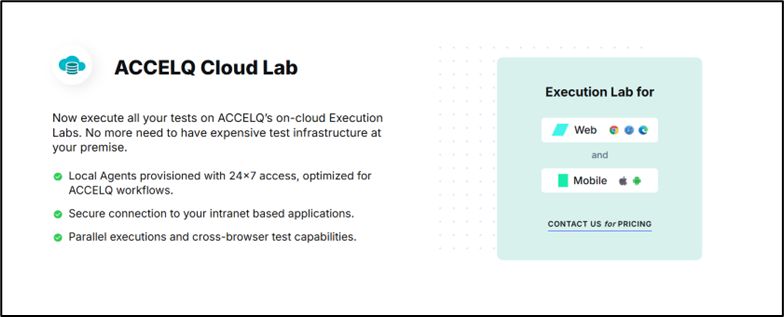
ACCELQ mainly offers you four deployment models which are public cloud, private cloud, hybrid cloud, and on-premise.
1. Private Cloud
In this deployment model, you get a dedicated single tenant instance which can be hosted and managed either by ACCELQ on a dedicated cloud infra, or it can be deployed within your own Virtual Private Cloud.
However, execution still typically occurs via a Local Agent installation. This means you’ll need to constantly maintain and keep the agent updated for every execution machine.
And because execution depends on Local Agents, scaling requires provisioning and maintaining additional agent nodes rather than dynamically expanding infrastructure on demand.
2. Public Cloud with hybrid execution
Here, the infrastructure is fully managed by ACCELQ on their secure multi-tenant cloud like AWS, Azure, or GCP and the ACCELQ Local Agent is installed in your private networks and behind your firewall.
You can opt for this model if you want to outsource the management of upgrades, backups, and security and a secure communication channel to fetch test data and results.
Because ACCELQ manages the underlying cloud infrastructure, customization at the infrastructure layer is limited compared to an infra-first platform like TestGrid. Teams rely on standardized configurations and upgrade cycles defined by ACCELQ.
3. Full on-premises deployment
ACCELQ offers secure and flexible deployment options, but
- To run tests locally inside your firewall, you’ll need to install the ACCELQ Local Agent
-
On-premises deployment has fairly heavy software and hardware requirements:
- Minimum 8 GB required for 2 run browsers, and for each additional browser instance, you’ll need to add 1.5 GB of RAM
- At least RAM 8 GB and Quad-core CPU is required to support 2 browser instances efficiently
- Java Development Kit (JDK), not just the Java Runtime Environment (JRE)
If infrastructure control is important, ACCELQ may feel restrictive because its execution model centers around agents rather than infrastructure-aware orchestration.
On-Prem Execution Resource Management: TestGrid vs AccelQ
Modern QA teams need predictable, controllable execution infrastructure, especially when dealing with real on-prem devices, parallel suites, and large-scale CI pipelines. TestGrid is designed specifically for this use case: centralizing how teams allocate devices, trigger executions, and monitor infra health in real time.
TestGrid: Infra-first execution intelligence
TestGrid gives you a unified control layer for real devices, browsers, and on-prem execution infrastructure. With ONOREM, teams can:
- Control the entire test lifecycle including CI/CD triggers, environment selection, and execution routing
- Reserve on-prem devices for fixed durations ensuring session stability and no unwanted resets
- Run tests in parallel across real devices and browsers—locally, hybrid, or cloud
- Access private device labs securely via enterprise VPN, SSO, or role-based permissions
- Monitor device health and availability, queue depth, execution load, and live test progress from a single dashboard
This makes TestGrid infra-aware rather than agent-dependent, giving enterprises full clarity into device utilization and execution performance.
ACCELQ: Agent-centric execution
ACCELQ supports parallel test execution using agents installed in your environment, which works well for typical web and API automation use cases.
However, ACCELQ’s execution model is agent-driven rather than infrastructure-driven. It doesn’t provide device-level orchestration such as device reservation, allocation, or on-prem hardware scheduling.
Its execution model is centered around Local Agents rather than infrastructure. Monitoring focuses on agent status and test runs, not real-time device metrics or infra utilization.
Open Source Code Access: Flexibility vs Lock-In
TestGrid: Supports open-source frameworks and script exports
With TestGrid, you can choose from both codeless test authoring and full-code automation using popular open source frameworks like Appium, Selenium, and Cypress.
If you already have test scripts, TestGrid has built-in support for open source frameworks like Selenium, Appium, and Cypress helps you edit your code based on your requirements.
- You can execute local Appium scripts on TestGrid’s scalable and secure Appium test execution cloud
- Test your website & web apps faster on a secure & scalable Selenium grid powered by TestGrid
- Run your Cypress tests by downloading your config, installing the CLI, and executing tests on a scalable cloud
TestGrid also allows script export and integrates with external Git workflows so you can manage and maintain code outside the platform like any other codebase.
Plus, with CoTester, an AI agent by TestGrid designed for software testing, you can get full code ownership of the tests it generates. You can directly edit and customize your scripts manually inside CoTester’s IDE.
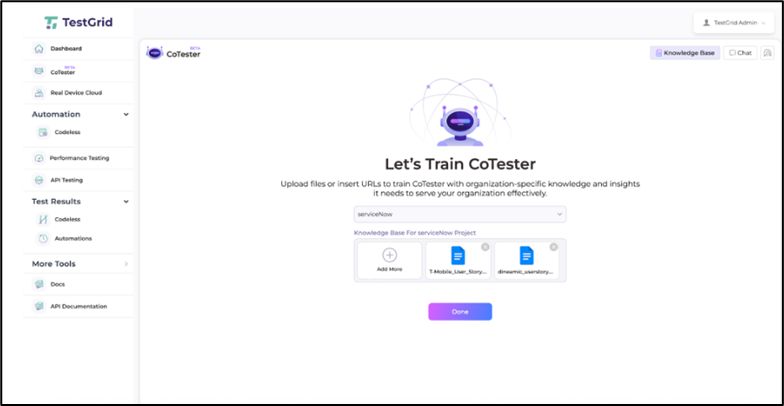
So, if you want tight open source software alignment and the comfort of still being able to fall back to Selenium or Appium code or other open source frameworks, TestGrid can be more fitting for you.
ACCELQ: Proprietary and model-based
ACCELQ allows you to develop test logic in natural language and create tests through its model-based interface using visual editors or natural language abstraction. However, it’s it is primarily proprietary, which means you can build and edit your scripts only inside the platform’s own UI.
Also, you can't export code from ACCELQ or directly manage test scripts in external Git repositories. Since ACCELQ uses a proprietary modeling system, test logic remains inside the platform and can't be exported as open-source code.
This is a limitation for QA teams who want the freedom of writing test code and prefer open-source framework integrations.
AI Philosophy: NLP-Led Modeling vs Agentic Bulk Code Generation
TestGrid: Agentic AI for bulk code generation and autonomous execution
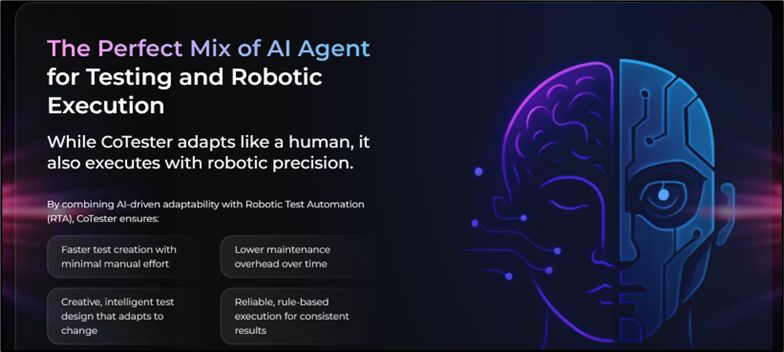
CoTester by TestGrid, a dedicated AI agent for software testing, combines agentic AI adaptability with Robotic Test Automation (RTA) to create tests in bulk and faster. Here’s how CoTester lets you write, debug, and execute suites of tests at scale and with speed:
- Instantly create tests by uploading or linking your stories from JIRA and the test case authoring agent turns your specs into full test logic
- Automatically look for bugs, flag them, and log them, and get live feedback for clear visibility into issues the moment they happen
- CoTester learns your product context and adapts to your QA workflows and then writes all your test code for you
- TestGrid’s AI-powered auto-heal engine AgentRx, automatically detects even major UI changes, full redesigns and structural shifts, and updates your test logic on the go
- CoTester learns from every feedback and adapts to your testing processes, and reduces test flakiness
These are the features that would be absolutely essential for organizations that want to scale automation in 2025 and forward.
So, if you want to integrate AI deeply into your development workflows to speed up testing and delivery cycles and make pipelines more productive, TestGrid clearly has an edge.
ACCELQ: NLP-style modeling, strong self-healing, but limited AI depth
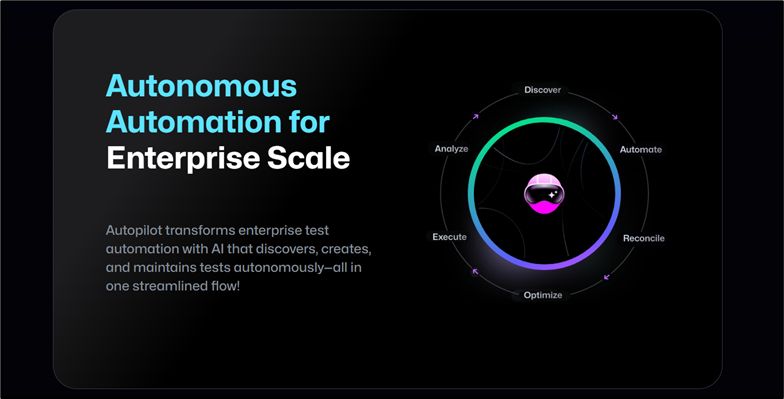
ACCELQ’s Autopilot is powered by GenAI and NLP-like modeling which helps you generate test cases via plain English prompts and with realistic data covering various scenarios. Autopilot identifies and maps out end-to-end test scenarios within an app context and provides a detailed step by step logic for seamless workflow automation.
ACCELQ’s Autopilot is good for self healing and can dynamically adapt to app changes by using the core semantic and functional attributes rather than just depending on HTML locators.
However, ACCELQ doesn't offer agentic AI capabilities such as bulk code generation, multi-step reasoning, or autonomous execution coordination. Its AI primarily focuses on NLP-style modeling and self-healing.
And these capabilities are critical because, as apps become more complex, teams would need platforms that can understand UI, API, data, and workflow changes together, adapt to changing user behavior, generate and execute tests with speed, and keep up with microservices releases.
TestGrid, as we’ve seen, offers you all these and more.
User Experience & Learning Curve
TestGrid
TestGrid offers you a clean, lightweight UX which helps you start right away without investing too much in training and adoption.
The platform’s codeless automation and record and play feature can help teams move seamlessly from manual to automated testing without extensive coding knowledge. Teams can also choose code-based authoring and edit tests easily in CoTester’s IDE.
This is a big advantage for teams having members from tech and non tech backgrounds.
ACCELQ
ACCELQ’s codeless automation reduces the barrier to entry for QA teams without deep programming skills. This makes it easy for even non tech teams to build tests easily. Although the basic automation is straightforward, testing can get complex for advanced workflows, customizations, and integrations.
Since ACCELQ mainly offers codeless testing interfaces, it can be difficult to use for teams who want scripting flexibility. Plus, advanced features and deeper customizations might need more time to get familiar with, and as workflows scale, it increases cognitive load.
ACCELQ vs TestGrid: A head-to-head comparison of user experience and learning curve
| Category | ACCELQ | TestGrid |
|---|---|---|
| Overall UX | Polished, enterprise-grade, but dense | Lightweight, clean, low-friction interface, easy navigation |
| Tester feel | Powerful but heavy; easy for basic tests but overwhelming to manage as scenarios grow | Feels simple, uncluttered, and easy to use; less mental overhead; smooth navigation |
| Onboarding complexity | Full proficiency in test creation requires learning ACCELQ’s modeling framework; advanced workflows take longer | Fast adoption; testers can create executable tests within minutes with help of CoTester |
| Scripting experience | Primarily codeless; scripting tied to ACCELQ’s proprietary environment | Supports scriptless, low-code, and full-code; flexible for DevOps, QA, and business teams |
| Best for | QA teams and enterprises comfortable with structured, vendor-modeled workflows | Modern engineering and QA teams that want straightforward testing interface, flexible scripting options, fast test generation |
At-a-Glance Comparison Table
If you’ve come this far, this quick TestGrid vs ACCELQ comparison will help you understand their strengths and features so you can make a more confident decision.
| Category | ACCELQ (limitations) | TestGrid (advantages) |
|---|---|---|
| Usage | Designed for ERP workflows and QA (SAP, Salesforce, Oracle); less aligned with engineering-led workflows needing open-source and infra control | Built for QA, DevOps, product orgs that need fast iterations and engineering velocity |
| Enterprise depth | No device-level MDM or real-device metrics; limited infra visibility | Full MDM, metrics, unified reporting across infra and executions; real-time metrics for device-usage and runtime |
| ERP support | Strong accelerators but rigid, vendor-locked | Flexible UI/API testing for any ERP apps without lock-in |
| Own infra | Cloud-first, heavy on-prem deployment requirements; no native device farm support | Cloud, hybrid, on-prem, private device lab with real Android and iOS devices |
| ONOREM | Missing real infra resource management | Full execution pipeline control; support for device-scheduling; parallel execution across devices and browsers at scale |
| Open source support | Proprietary, no-script export | Selenium/Appium/Cypress integration; script export |
| AI philosophy | Supports NLP modeling and strong self healing; no bulk generation and adaptive agentic AI | Agentic AI, bulk test creation, auto-debug, aggressive healing |
| User experience | Good for non-tech; heavy for engineers; steep learning curve for advanced features | Lightweight, intuitive UX for all roles; faster adoption, clean interfaces for scriptless and code-based authoring |
| Enterprise nature | Heavy, governance-first | Modern, agile, infra-first |
Final Verdict: When Each Tool Makes Sense
ACCELQ is not a bad product, but it’s just not built for modern product engineering teams.
TestGrid, on the other hand, gives fast-moving engineering teams the speed and flexibility they need with minimal overhead.
TestGrid’s real device cloud and a unified test-ready infrastructure help you reduce heavy setups; you don't have to manage hardware labs or separate environments, which increases testing velocity. And its AI-driven codeless authoring and record and play test creation facilitates fast onboarding and reduces friction for teams with varied skill sets.
TestGrid is engineering-first, infra-first, AI-first.
Use TestGrid if:
- You’re a SaaS, product engineering, or digital-native organization that wants AI-first automation
- You want your own testing infrastructure (private cloud, on-prem and private device labs) for compliance and data privacy
- You need real-device execution at scale and parallel execution across browsers and operating systems
- You want open-source flexibility to customize test code as per your testing requirements
- You want bulk test generation with agentic AI, live feedback, and auto-debugging options
So, if you’re looking for an AI-first infra-aware platform that gives you unified control over automation and execution environments, TestGrid is the one for you.
The platform supports full-stack testing, including functional, performance, visual, cross-browser, and API testing, along with CI/CD integrations which give you an end-to-end testing ecosystem.
For modern teams building fast-moving products, TestGrid is the more strategic long-term choice.
Author
Hi, I’m Ankita, a content writer who believes good content should build trust, encourage conversations, and create value. With a Master’s in Marketing and experience writing for digital marketing, SaaS, and tech, I help brands tell stories that drive engagement and leave a memorable impact on their audience.