
8 Best AI Test Automation Tools for 2027
By Danko Petrovic ·

Looking for the best AI test automation tools in 2027? Here's a quick guide to the top 8 tools transforming software testing with AI-driven features like self-healing, intelligent test creation, and predictive analytics. These tools save time, reduce manual effort, and improve test accuracy across web, mobile, and desktop platforms.
Key Highlights:
Testim: Simplifies test creation with AI and self-healing features.
Applitools: Specialized in visual testing with smart comparison.
Katalon Studio: Offers AI-based test creation and analytics.
ACCELQ: Agentic AI Test Automation
Mabl: Focuses on machine learning for agile workflows.
TestGrid: Script-free testing with real device support.
BrowserStack: Cross-platform testing on 3,000+ devices.
LambdaTest: Visual regression testing and CI/CD integration.
Quick Comparison Table:
Tool | AI Features | Platforms | Pricing | Integrations |
|---|---|---|---|---|
Testim | Self-healing, test authoring | Web, Mobile, API | $300+/month | |
Applitools | Visual AI, smart maintenance | Web, Mobile, Desktop | Contact vendor | |
Katalon Studio | Object recognition, analytics | Web, Mobile, API | $159+/month | Azure DevOps, Jira |
ACCELQ | Agentic testing automation platform | Web, mobile, API, desktop, packaged apps | Custom pricing | Azure, Jira, Jenkins |
Mabl | Self-healing, ML insights | Web, API | $400+/month | GitHub, Slack |
TestGrid | Script-free, real devices | Web, Mobile, Desktop | $200+/month | Azure DevOps, Jenkins |
BrowserStack | Visual regression, debugging | Web, Mobile | $129+/month | GitHub, Travis CI |
LambdaTest | Self-healing, visual testing | Web, Mobile, Desktop | $158+/month | Jenkins, TeamCity |
These tools are reshaping software testing with smarter automation and better efficiency. Choose the one that fits your team's needs, budget, and tech stack.
Best AI Tools for Software Testers: AI in Automation Testing
1. Testim
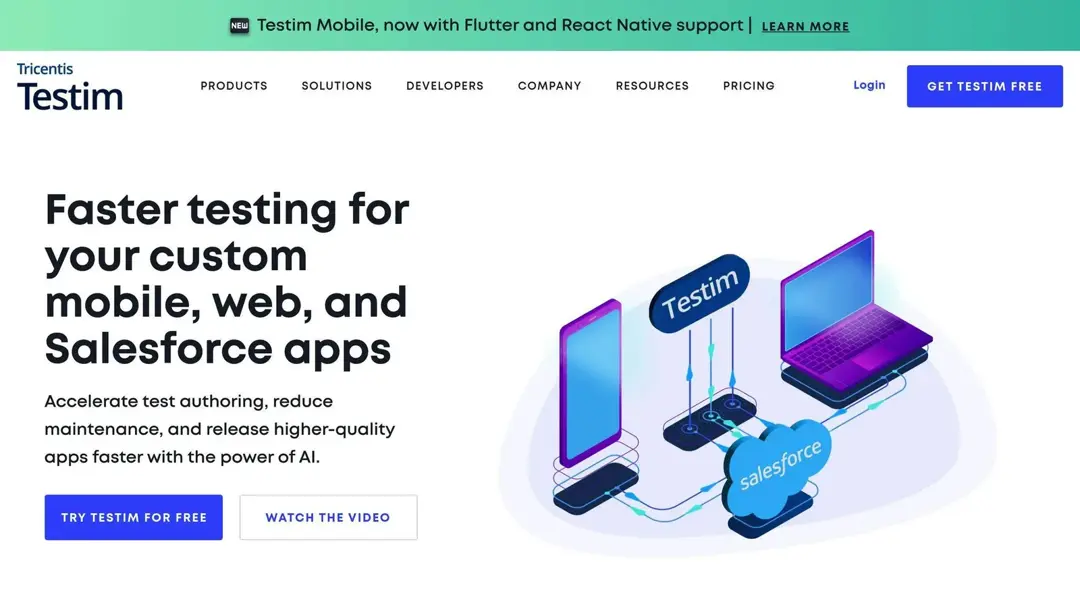
Testim uses AI to simplify software testing with smart test creation and self-healing features. It blends advanced automation with easy-to-use tools to meet modern testing demands.
With Testim, you can turn plain text into test cases, making test authoring faster and improving test coverage. The platform also scans test code to spot issues and suggest fixes, saving time during the test creation process.
One standout feature is its self-healing AI, which automatically updates test scripts when applications change. This reduces the need for manual updates, prevents broken tests, and ensures consistent reliability even as software evolves.
Testim integrates effortlessly with CI/CD pipelines, giving instant feedback on code changes to help resolve issues quickly. It works with any Selenium-compatible grid, allowing tests to run across various environments without hassle.
The platform's visual editor makes customizing tests straightforward, while an AI-powered assistant provides quick access to helpful resources. Testim supports both web and mobile testing, offering a complete solution for today's applications.
For enterprises, Testim shines by keeping tests stable even during frequent updates. Its ability to create reliable, low-maintenance tests helps reduce technical debt, making it a strong choice for organizations upgrading their testing processes.
Testim demonstrates how AI can cut down manual work while boosting test accuracy and scalability. Its features set a high bar for AI-driven test automation, inspiring further advancements in tools like Applitools.
2. Applitools
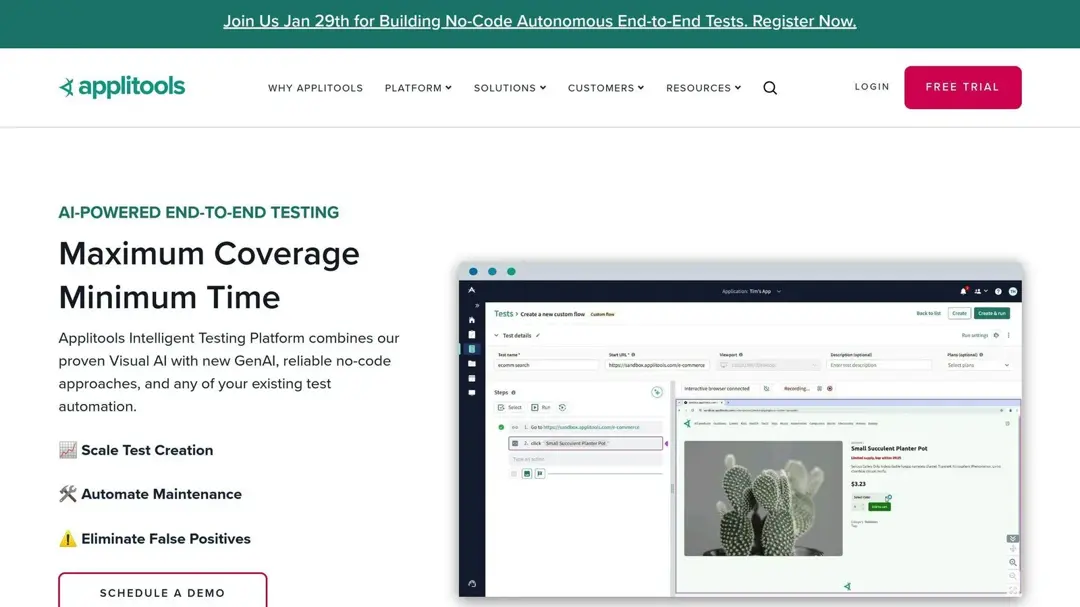
Applitools uses Visual AI combined with test automation to catch visual bugs and check UI elements across different platforms. Its smart comparison engine cuts down on false positives, making tests more accurate and easier to maintain. With AI at its core, the tool reduces the need for manual work, simplifying the testing process.
Its self-healing AI adjusts to changes in the UI, keeping visual consistency intact without needing constant manual updates. This feature is especially useful during frequent UI updates, cutting maintenance time by up to 90%.
Applitools works seamlessly with tools like Selenium and Appium, allowing teams to add visual testing to their workflow without needing extra infrastructure. It supports web, mobile, and desktop applications, offering broad coverage through one platform.
The built-in analytics dashboard helps teams spot trends in test failures, monitor performance metrics, and make smarter decisions to refine their testing approach. Features like detailed reporting on test coverage, execution times, and failure analysis add extra value.
Its cross-browser testing capabilities ensure consistency across multiple browsers and versions while saving time during execution.
For teams new to AI-powered testing, Applitools offers thorough documentation and tutorials, making it easy to get started. Most teams become proficient within weeks of using the platform.
Applitools is particularly effective for regression testing, where visual accuracy is a top priority. Recent updates have tackled challenges like dynamic content and shadow DOMs, which are common in modern web testing.
While Applitools focuses on visual testing, the next tool, Katalon Studio, offers a broader set of AI-driven testing features.
3. Katalon Studio
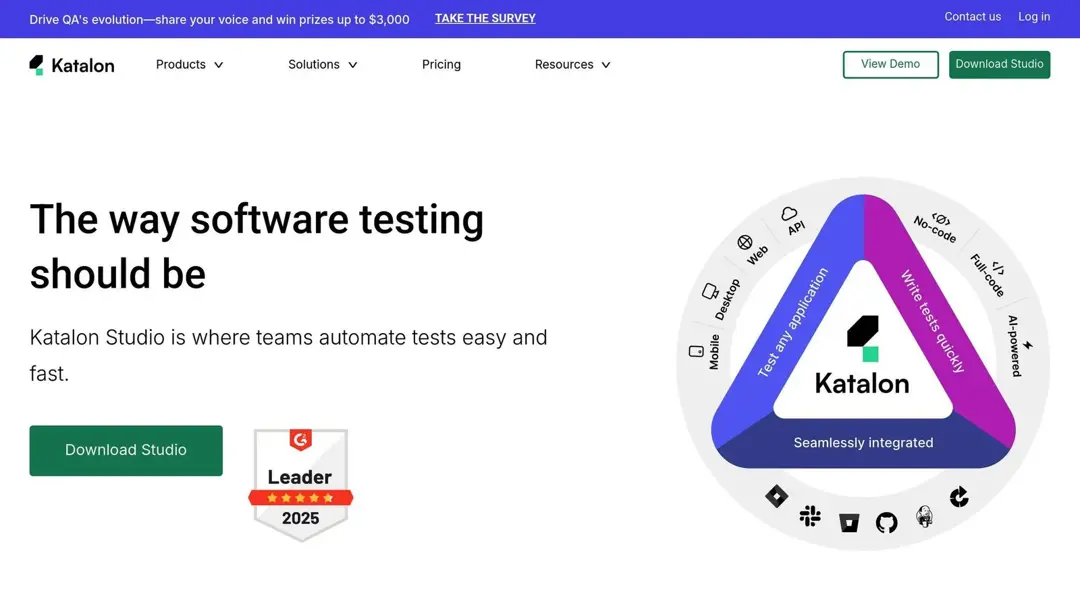
Katalon Studio is making waves in the 2025 AI testing space with its advanced approach to test automation. Its AI-powered features have grown substantially, offering a strong option for teams aiming to streamline their testing processes.
One of its standout features is its AI-based test creation system, which automatically generates test cases by examining application behavior. This approach has helped many organizations improve testing efficiency and reduce defects.
Another key feature is its self-healing automation. This function uses intelligent element detection and dynamic script updates to handle complex application changes, cutting down on maintenance efforts while keeping tests reliable.
Katalon Studio also offers detailed analytics, tracking important metrics like test duration, success rates, and defect density. It supports testing across web, mobile, and desktop platforms, and integrates seamlessly with leading CI/CD tools, simplifying workflows.
For teams new to AI-driven testing, Katalon Studio provides thorough documentation and a supportive community. It’s available in both free and paid versions. While there’s a learning curve, the platform’s advanced capabilities make it worth the investment.
Recent updates have enhanced scenario detection and minimized false positives, making it particularly useful for complex testing environments where traditional tools often fall short.
Katalon Studio demonstrates how AI can transform test automation by reducing manual tasks and improving reliability. It's a strong contender in the field, but next, we’ll look at how Mabl takes a different approach to AI-driven testing.
4. ACCELQ
Best for: Teams that want AI agents to carry test discovery, creation, and maintenance across the full application stack.
Overview
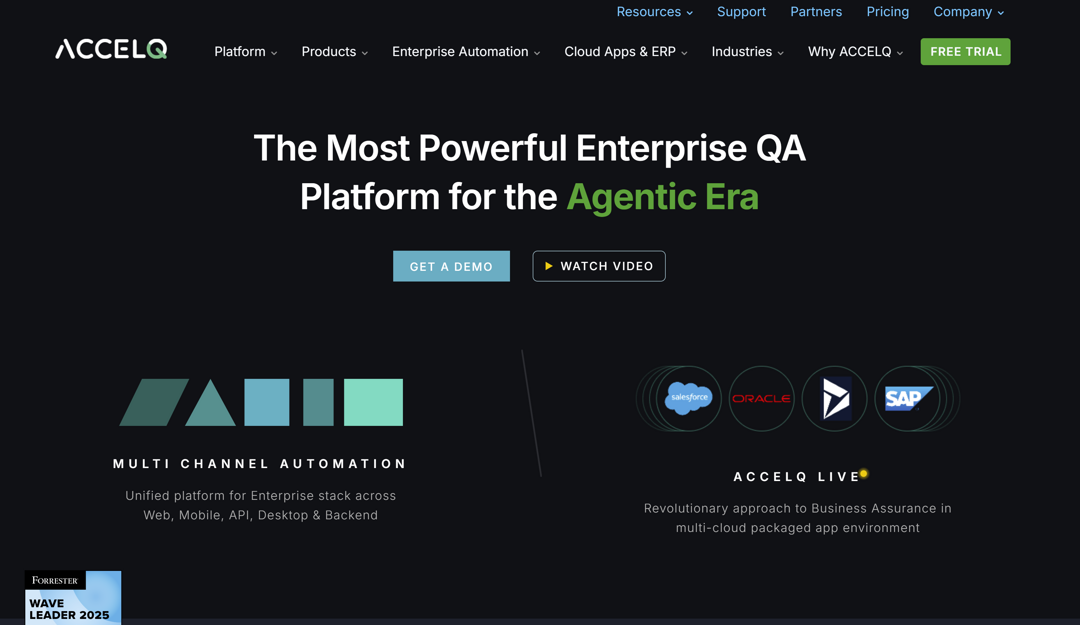
ACCELQ is an agentic testing automation platform. AI agents map the application, design the tests, and keep them current as releases ship. Teams model the application once in the ACCELQ Universe, describe test logic in everyday English with QGPT Logic Builder, and let Autopilot expand a single business scenario into multiple test variations. The same platform covers web, mobile, API, desktop, and backend layers, plus packaged apps like Salesforce, Oracle, and SAP.
Key AI Capabilities
Universe Discovery: maps pages, components, and end-to-end flows into a reusable application model that every test builds on.
QGPT Logic Builder: turns plain English descriptions into executable test logic.
Autopilot: the agentic engine that generates test scenarios, variations, and data permutations from a business scenario.
Autonomous Healing: adapts tests to UI and API changes, including changes beyond the application DOM.
Design-First AI-Architect: recommends modular design and parameterization so suites stay maintainable as they grow.
AI Test Data Generation: produces realistic data that covers business rules and edge cases.
Pros
One platform covers UI, API, mobile, desktop, and packaged apps.
Healing and modular design cut the maintenance work that drains most automation budgets.
Business analysts and manual testers can contribute because tests read in everyday English.
Integrates with CI/CD pipelines and development tools.
Cons
The platform is broad, so onboarding takes a planned rollout.
Teams that prefer writing every test as code in their own IDE will find the model-driven approach a different way of working.
Pricing: Custom pricing based on scope. Book a demo to get a quote.
Verdict: ACCELQ fits QA teams that want AI agents to handle discovery, design, and healing across a mixed application stack. Book a demo to see Autopilot on your own application.
5. Mabl
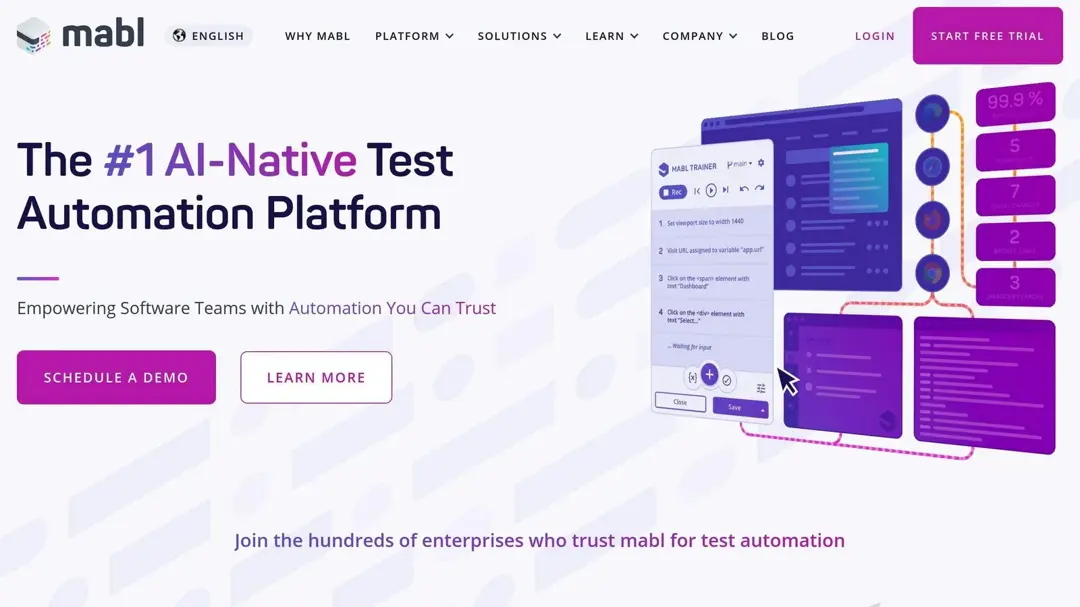
Mabl stands out for its use of machine learning to power intelligent test automation, making it a great fit for agile teams working through fast-paced development cycles.
One of its key features is the AI-driven test creation system. By analyzing user interactions and application behavior, Mabl can automatically generate detailed test scripts. This drastically cuts down on the time teams spend on manual scripting, letting them focus on higher-level testing strategies.
Another highlight is Mabl's self-healing automation. Using machine learning, the platform adjusts scripts automatically when UI or functionality changes occur. This reduces the need for manual updates, ensuring smooth testing even during rapid development changes.
Mabl also provides strong analytics tools, offering real-time insights tailored for agile workflows. Teams can monitor metrics like test coverage and failure trends, helping them optimize test suites and allocate resources effectively.
The platform supports cross-platform testing across web, mobile, and desktop applications. Its cloud-based environment ensures consistent test results across browsers and devices, making it a solid choice for organizations with varied testing demands.
For those new to AI-driven testing, Mabl offers detailed documentation and support, easing the transition. It also integrates with CI/CD tools, streamlining workflows for development teams.
Recent updates have introduced performance and accessibility testing capabilities. Mabl is especially useful for projects with frequent UI updates, as its AI-powered automation keeps tests stable and reduces maintenance efforts. It’s a strong option for teams navigating the evolving testing landscape.
While Mabl focuses on intelligent automation and multi-platform support, Perfecto takes a different route with its emphasis on cloud-based testing.
6. TestGrid
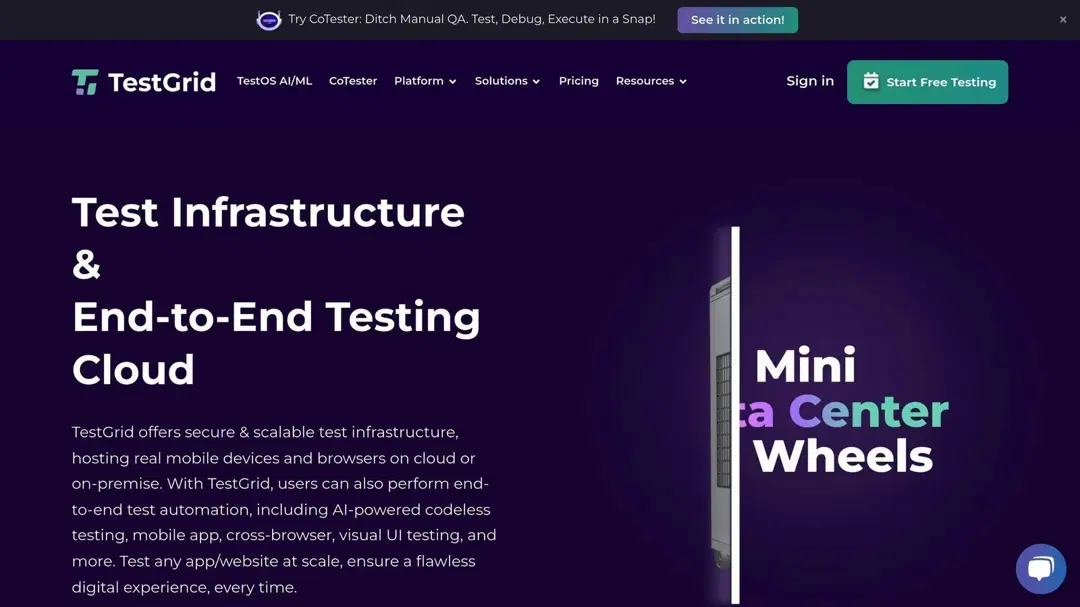
TestGrid is a cloud-based platform designed for end-to-end testing automation. It simplifies test creation by offering a script-free, AI-powered system that caters to testers of all experience levels. This allows teams to build test cases that adjust automatically as applications evolve, maintaining consistent testing coverage.
With TestGrid, teams can run tests on real devices across various browsers and operating systems simultaneously. This ensures applications perform smoothly on different platforms and screen sizes, giving users a consistent experience.
The platform's analytics engine plays a key role in identifying gaps in testing. By leveraging AI, it pinpoints potential issues and fine-tunes test suites to improve efficiency. Additionally, TestGrid's self-healing automation reduces the hassle of maintaining test scripts by adjusting them to interface changes automatically.
TestGrid integrates easily with CI/CD pipelines, making it a great fit for automated testing workflows. It supports popular frameworks and tools, while its parallel execution feature helps teams save time - especially useful for large-scale testing projects.
The platform also includes an AI-driven assistant, providing users with quick access to documentation and best practices. This feature helps reduce the learning curve, making it easier for teams to get started. Flexible pricing plans are available to suit teams of different sizes.
TestGrid stands out with its focus on real-device testing and accessibility, offering a practical option for AI-driven testing. While it shines in areas like real device cloud and customization, alternatives like BrowserStack focus more on cross-browser compatibility, presenting users with different strengths to consider.
7. BrowserStack
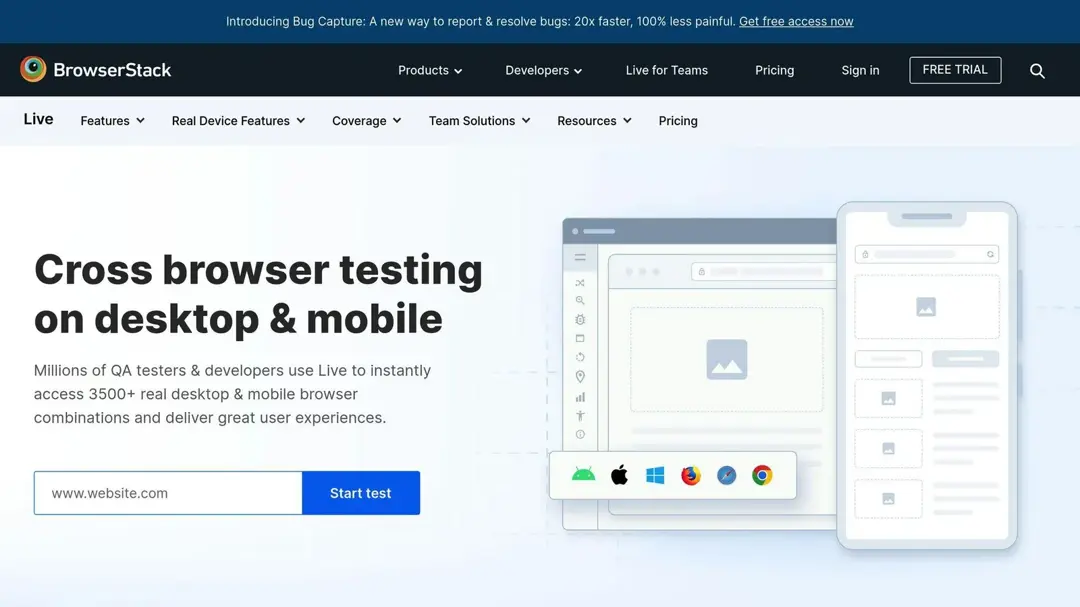
BrowserStack offers a powerful mix of AI-powered automation and extensive cross-platform testing, giving access to over 3,000 real devices and browsers. This ensures your applications work smoothly across everything from the latest iOS gadgets to older Android models.
One standout feature is its self-healing automation, which adjusts test scripts automatically when interface changes occur. This is especially useful for apps that need to perform well across multiple platforms. By using BrowserStack, companies often cut test execution times by 70% and reduce maintenance efforts by 90%.
The platform also includes an analytics engine that helps teams identify testing bottlenecks and improve workflows with actionable insights. With its combination of AI tools and broad testing coverage, BrowserStack is changing how teams approach scalability and efficiency in software testing.
BrowserStack integrates effortlessly with popular testing frameworks like Selenium, Appium, and TestNG. This means teams can enhance their current workflows with AI-driven capabilities without starting from scratch.
Pricing is flexible, starting at $29/month, making it accessible for teams of all sizes. Big names like Microsoft, Twitter, and Expedia trust BrowserStack for their testing needs, thanks to its advanced features, wide device coverage, and strong analytics.
While BrowserStack is a leader in cross-platform testing and scalability, LambdaTest stands out in cloud-based testing with its own AI-driven tools and unique features.
8. LambdaTest
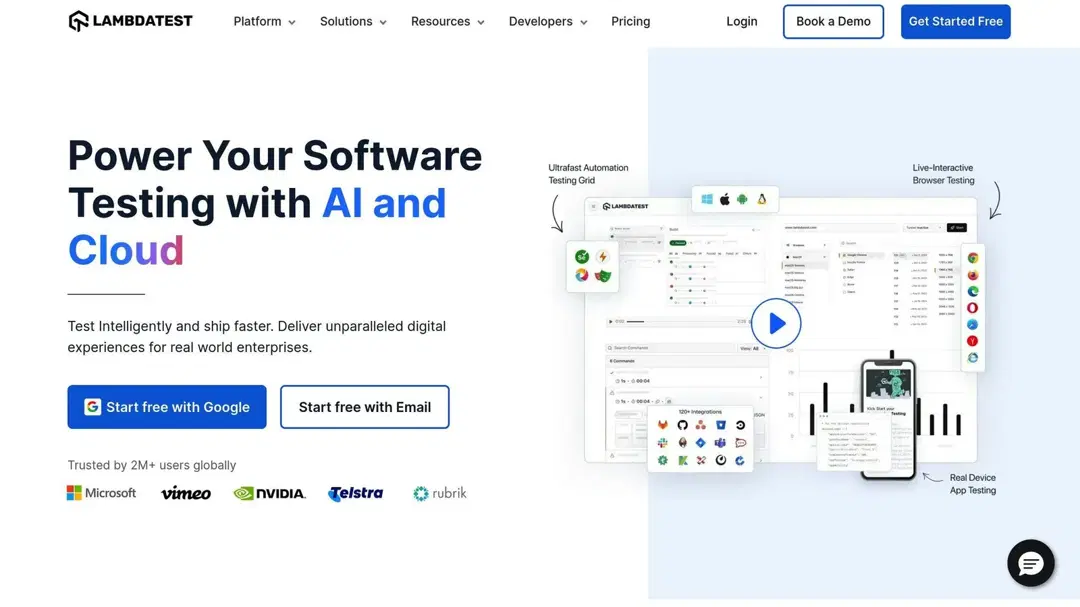
LambdaTest has made a name for itself in AI-driven testing, offering a cloud-based platform that simplifies cross-browser testing with speed and reliability.
One standout feature is its Smart Visual Regression Testing, which uses AI to spot UI inconsistencies across browsers and devices. For instance, Spotify integrated LambdaTest into their workflow and managed to reduce visual bug detection time by 60%, leading to faster releases.
Another highlight is the platform's self-healing automation. This feature adjusts test scripts automatically when interfaces change, saving significant time and effort. Adobe, for example, used this capability to cut test maintenance costs by 70%.
LambdaTest also integrates seamlessly with popular CI/CD tools like Jenkins, GitHub, and Jira, making it easy to include automated testing in development pipelines. Its analytics dashboard offers detailed insights into test performance, while parallel test execution has enabled companies like Microsoft to slash test execution time by up to 80%.
Key features include:
Smart Visual Testing for identifying UI issues across platforms.
Self-healing scripts that reduce maintenance efforts.
Access to over 3,000 real browsers and devices.
Smooth integration with CI/CD tools.
Support for various programming languages and frameworks.
These features make LambdaTest a practical choice for teams of all sizes, offering affordable pricing and the flexibility to work with existing tools and expertise. As the need for cross-platform compatibility and quicker releases grows, LambdaTest provides solutions to meet these challenges. While it excels in cross-browser and real-device testing, platforms like Gru.ai focus more on intelligent test creation and execution, offering a different perspective in the AI testing space.
Key Features:
AI-driven test creation and maintenance
Self-healing automation to adjust for UI changes
Multi-platform testing support
Real-time analytics and reporting
Easy integration with CI/CD tools like Jenkins and GitLab
Comparison Table
Here’s an overview of the top AI test automation tools in 2025, highlighting their features, supported platforms, pricing, and integrations. This table is designed to help you choose the right tool for your testing requirements.
Tool | AI Features | Platforms | Pricing | Integrations |
|---|---|---|---|---|
Testim | • Test authoring | Web, Mobile, API | $300+/month | Jenkins, CircleCI, GitLab |
Applitools | • Visual AI | Web, Mobile, Desktop | Contact vendor | Selenium, Cypress, TestCafe |
Katalon Studio | • Object recognition | Web, Mobile, Desktop, API | $159+/month | Jenkins, Azure DevOps, Jira |
ACCELQ | • Autopilot | Web, mobile, API, desktop, packaged apps | Custom pricing | Azure, Jira, Jenkins |
Mabl | • Self-healing | Web, API | $400+/month | GitHub, BitBucket, Slack |
TestGrid | • Test optimization | Web, Mobile, Desktop | $200+/month | Azure DevOps, Jenkins, Jira |
BrowserStack | • Visual regression | Web, Mobile | $129+/month | GitHub, Travis CI, Circle CI |
LambdaTest | • Visual regression | Web, Mobile, Desktop | $158+/month | Jenkins, Bamboo, TeamCity |
Pricing details are accurate as of January 2025. Many tools also offer custom enterprise pricing and free trials.
Key Highlights
Here are some standout features across the tools:
Testim: Simplifies test maintenance with efficient self-healing capabilities.
Applitools: Offers unmatched accuracy in visual testing.
ACCELQ:
Mabl: Provides advanced machine learning-driven insights.
Choosing the right tool depends on factors like your testing needs, team size, budget, and current tech stack. Use this table as a starting point to match your requirements with the features offered by these tools.
Conclusion
AI test automation tools in 2027 have reshaped software testing, making it faster, more precise, and scalable. These advancements have shifted QA teams away from manual, time-intensive methods to smarter, automated approaches that keep up with evolving codebases.
By addressing long-standing issues like test flakiness and high maintenance demands, AI-powered tools have become essential for modern development. Features like self-healing tests, visual recognition, and multi-environment support reduce manual work and improve accuracy. Cloud-based platforms such as TestGrid and LambdaTest streamline workflows, while AI-driven insights help expand test coverage and boost efficiency.
However, choosing the right tool requires careful evaluation. Organizations should consider:
Learning curve and technical expertise required for the tool
Integration capabilities with current CI/CD systems
Budget and ROI expectations for the investment
Support for platforms like web, mobile, and API testing
The tools highlighted here represent the forefront of AI-driven test automation, each offering unique solutions for diverse challenges. A gradual rollout and proper team training can ensure smooth adoption and maximize the benefits.
AI-powered automation is paving the way for faster, higher-quality software delivery, keeping pace with the demands of modern development. Choosing the right tool can transform your testing process and help you deliver exceptional results.
FAQs
What is the best AI testing tool?
The "best" AI testing tool often depends on your project's specific requirements. However, as of 2027, mabl has gained attention for its low-code AI automation, self-healing features, and built-in performance testing. It's particularly well-suited for web applications requiring thorough testing. With its use of intelligent automation and machine learning, mabl allows teams to start testing earlier in the development process.
Which automation tool is in demand in 2027 for testing?
In 2026, tools like Applitools (for visual testing), LambdaTest (for cross-browser testing), and Cypress (geared towards developers) were highly sought after. This reflects a growing interest in AI-driven solutions that simplify testing, reduce upkeep, and integrate smoothly into CI/CD workflows. By 2027, AI-powered tools are expected to lead the market due to their ability to improve both efficiency and precision.
"AI is changing the pace the world moves and the way we develop software applications. The Testim platform is built with AI at its core to meet these challenges." - Testim
These shifts highlight the importance of choosing the right AI-driven tool to keep up with evolving testing needs.